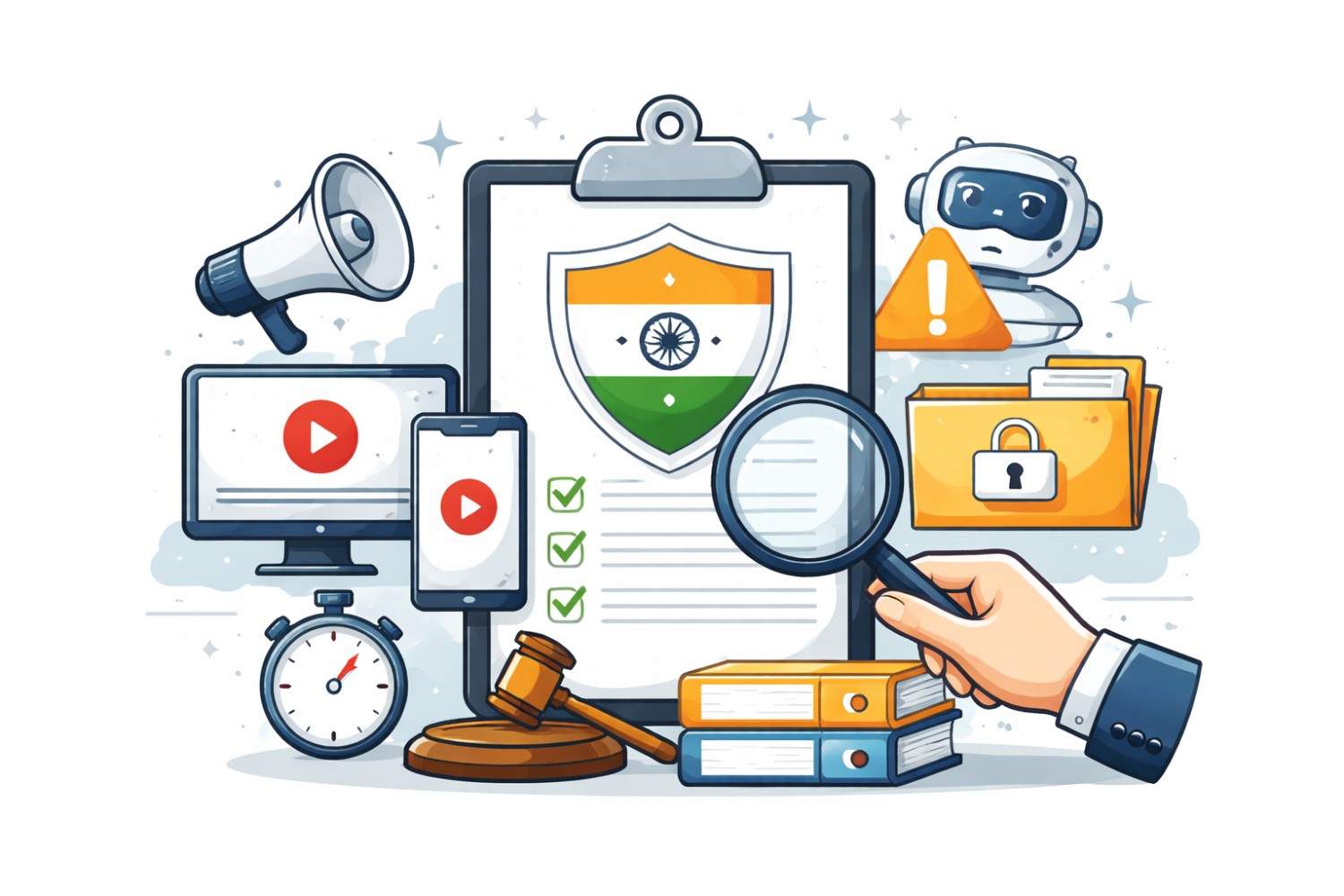
Key Changes in India’s IT Rules and What Publishers Must Know
India’s digital governance landscape has entered a new phase with recent changes to the Information Technology (Intermediary Guidelines and Digital Media Ethics Code) Rules, 2021 — commonly referred to as the “IT Rules.” These updates, part of the IT Amendment Rules, 2025/2026, introduce significant compliance obligations for publishers, social media platforms, digital news outlets, and other intermediaries that host or distribute online content. The revised rules come into force in stages beginning February 20, 2026, under an official notification (G.S.R. 120(E)).
This article explains the key regulatory changes within the updated IT Rules and what content publishers operating in India must know to comply with the evolving digital legal framework.
1. Tighter Takedown Compliance: 3-Hour Deadline
One of the most consequential changes mandates that platforms remove alleged unlawful content within three hours of receiving a valid complaint or government notification. This is a sharp reduction from the previous 36-hour window that was widely viewed as standard under the earlier rules.
- Applicability: All social platforms and intermediaries that host content, including news portals, forums, and comment sections.
- Implication for Publishers: Must integrate rapid review and escalation protocols to respect takedown notices and legal orders within the new deadline.
Industry actors have called this timeline challenging, citing operational constraints and the need for legal assessment before action; digital rights advocates have also raised concerns about potential over-reach.
2. Mandatory AI-Generated Content Labelling
The amended rules introduce mandatory labelling of AI-generated content. Platforms that publish or redistribute synthetic media — including videos, audio, images, or text created wholly or partially by artificial intelligence — must clearly identify these with a visible label.
- Objective: Improve transparency and help users distinguish between human and machine-generated content.
- Obligation for Publishers: Ensure AI-assisted or AI-generated content carries an accurate label. Publishers should update workflows to flag such content before publication.
This move reflects growing regulatory concern about deepfakes, manipulated media, and misinformation, and aligns India’s approach with global trends in responsible AI use.
3. Structured Accountability for Removal Requests
Under the updated framework, content removal requests must be attached to a “reasoned intimation” that clearly spells out the legal basis, specific provisions invoked, and precise URLs or content identifiers. This ensures transparency and limits arbitrary or vague enforcement.
- Senior authorization: Only officers at or above the rank of Joint Secretary or equivalent can issue valid takedown intimations.
- Monthly review: Regulatory actions are subject to routine review by a senior authority to verify procedural fairness.
For publishers, this means platforms cannot act on informal or incomplete complaints — detailed legal context must accompany takedown directives.
4. Enhanced AI Safety and Misuse Controls
Alongside labelling requirements, the rules also impose quarterly warnings or penalties for users or publishers who repeatedly upload harmful AI-generated content after due notice.
Platforms and publishers must monitor and report patterns of non-compliance, integrating AI detection tools and automated workflows to enforce safe content standards.
5. Larger Compliance Burden for Social Media and News Publishers
The updated IT Rules reaffirm that large social media intermediaries and digital news media platforms must meet enhanced procedural obligations. These include:
- Explicit content governance policies published publicly;
- Grievance redressal mechanisms mapped to the revised legal timeline;
- Designation of compliance officers responsible for rapid response to notifications.
While these elements were part of the earlier code, the new rules embed them in stricter due-process requirements and heightened scrutiny.
6. Broader Digital Legal Environment: Data Protection and Privacy
Although not part of the IT Rules themselves, publishers should also align with the Digital Personal Data Protection Act, 2023, which governs how user data is processed, stored, and shared. Its phased rollout began in late 2025 and introduces a data protection board and compliance timelines for sensitive personal data.
Meeting both content moderation and data protection standards will be critical for publishers that collect or analyse user data.
What Publishers Must Do Now
Immediate steps for compliance:
- Audit content workflows to ensure AI-generated and user-generated content is labelled clearly.
- Upgrade takedown response infrastructure to meet the three-hour turnaround.
- Train compliance personnel on statutory reporting and reasoned intimation handling.
- Maintain transparent policy documentation online.
- Review data handling practices against the Data Protection Act.
Failing to meet these obligations risks legal and financial consequences, loss of intermediary safe harbour protection under the IT Act, and reputational harm.
Looking Ahead
India’s IT Rules reforms reflect a broader global trend toward greater accountability in digital spaces. While the tightened timetable and AI governance impose new operational demands, they also aim to foster a safer online environment for users and credible content for citizens.
For publishers, the imperative is clear: adapt quickly, invest in compliance systems, and integrate legal standards into everyday publishing operations to navigate India’s evolving digital regulatory landscape effectively.
This article is based on official notifications and verified news reporting. For precise legal advice, publishers should consult specialised legal counsel.
Last Updated on: Tuesday, February 10, 2026 11:39 pm by Republic Post Team | Published by: Republic Post Team on Tuesday, February 10, 2026 10:04 pm | News Categories: Education
About The Author